Image

How to stop it, and how to protect your harvest from it
Fall armyworm is a destructive pest that threatens crops worldwide. Despite the name, the fall armyworm is not a worm at all – it's a moth that spreads quickly, reproduces rapidly and can cause colossal yield losses for farmers around the world.
This page covers essential information about fall armyworm identification, treatment and intervention, as well as prevention strategies to safeguard harvests across different crops.
By understanding this pest and implementing effective management techniques, farmers can protect their crops and livelihoods from the ravages of fall armyworm infestations.
Native to the Americas, fall armyworm has spread rapidly around the globe, posing a severe threat to food security in many regions, particularly in Africa and Asia.
Research shows that globally fall armyworm costs farmers hundreds of millions of dollars every year in lost yields.
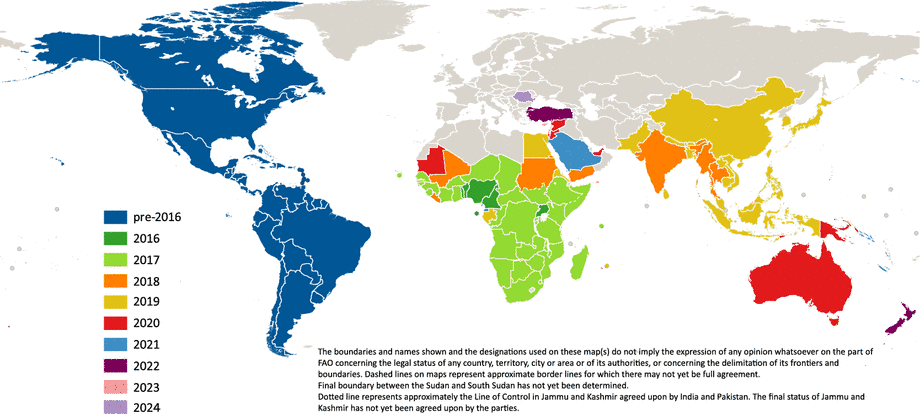
The global spread of fall armyworm
The worldwide spread of fall armyworm since 2016 (as of July 2024). Credit: The Food and Agriculture Organization of the United Nations
Fall armyworm (Spodoptera frugiperda) in their larval stage are highly polyphagous, meaning they feed on many plant species.
Their preferred foods are grasses, especially:
They can also feed on crops including cotton, soybean, groundnut/peanut, potato, tomato, onion and various vegetables, particularly when preferred grass hosts are unavailable.
This pest is particularly problematic for multiple reasons.

Rapid reproduction

Wide ranging

Migratory ability

Adaptability
Weather determines both how quickly fall armyworm develops and how far outbreaks can spread.
Warm conditions accelerate egg hatching, larval feeding and generation time, so populations can build rapidly during hot growing periods. In temperate areas, fall armyworm generally cannot survive sustained freezing conditions, and annual outbreaks often begin when moths migrate from warmer overwintering areas, aided by prevailing winds and storm systems.
Rainfall has mixed effects. Moderate rain can support lush host-crop growth and favorable humidity, while heavy rain may wash small larvae from plants or increase disease pressure.
Drought-stressed crops can be more vulnerable because larvae congregate on whatever limited green tissue is available. Late-planted maize and continuous availability of young cereal crops can also extend the window for damaging infestations.
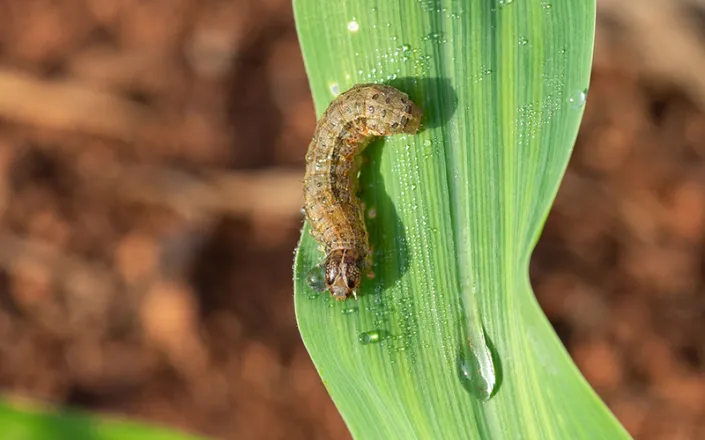
Farmers can identify fall armyworms by taking into account crop damage, larval markings and where on the plant the caterpillars are feeding.
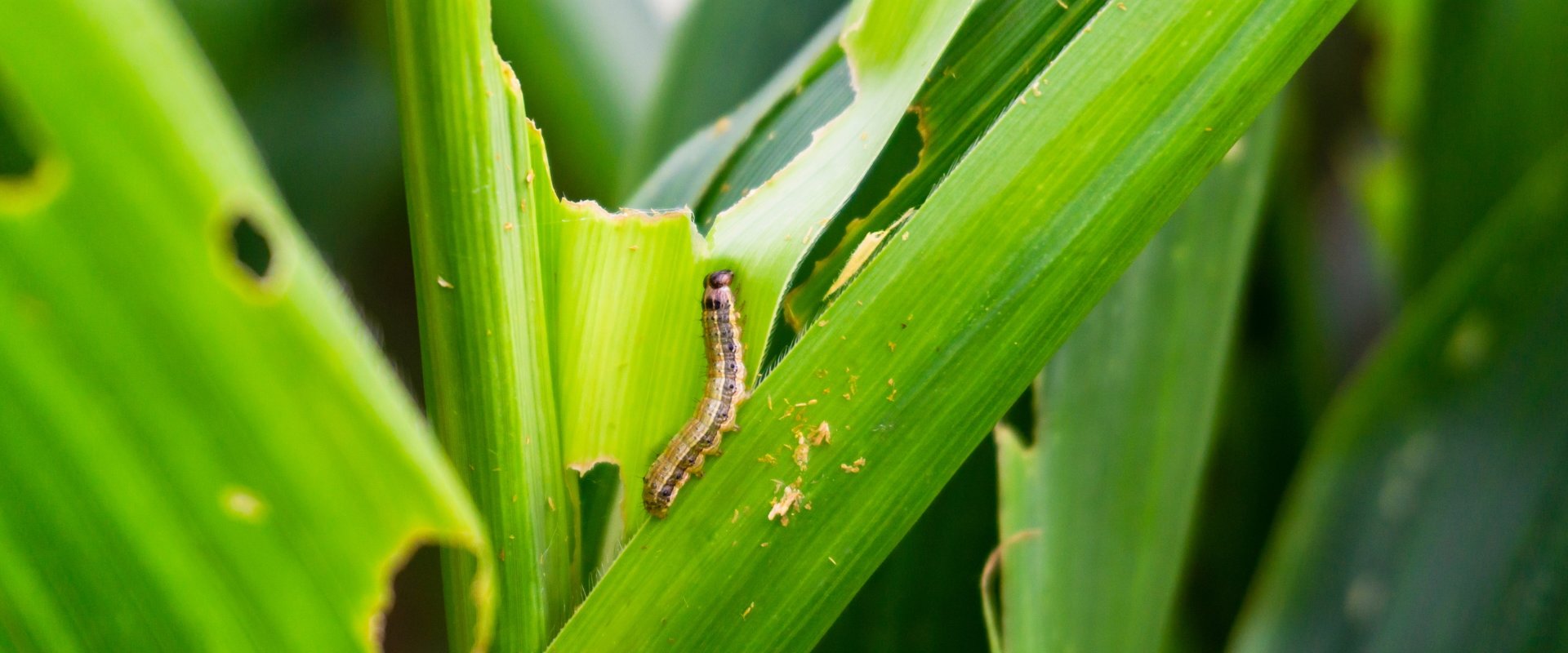
The most dependable field marker on larger larvae is a pale, inverted “Y” on the head capsule. On the rear of the body, the second-to-last abdominal segment has four dark spots arranged in a distinctive square.
The Fall Armyworm field handbook from the agricultural organization CABI and the FAO has useful information and strong visuals to help guide farmers in the field:
What is the difference between fall armyworm and corn earworm, cutworms, armyworms?
Usually feeds at the tip of the ear, often one large larva per ear because larvae are cannibalistic. Its skin has many tiny spines that feel comparatively rough, whereas fall armyworm is smoother and more commonly concentrated in the whorl during early crop stages.
These usually feed at or below soil level, cutting seedlings off at the stem. They often curl into a tight “C” when disturbed.
In contrast, fall armyworm may feed low on seedlings, but its classic maize damage is whorl feeding and can be spotted due to its inverted-Y head mark.
More often attack grasses, cereals and pasture, feeding openly on foliage and moving through crops in bands. They lack the characteristic inverted Y and four-spot square that distinguishes fall armyworm.
Often feeds on vegetables, sugar beet and cotton. Larvae usually show a more obvious lateral stripe and do not have the clear fall armyworm head-and-rear marking combination.
A good rule of thumb is that identification shouldn’t depend on damage alone. Whorl damage can be produced by several different caterpillars. It is prudent to collect several larvae, photograph the head and rear segments clearly, and confirm with a local crop adviser, extension service or plant-health authority especially as identification will impact treatment and pest reporting.

Identifying fall armyworm damage early is the key to successful treatment. Farmers and agricultural professionals need to be vigilant in monitoring their crops. Some of the most common symptoms include:
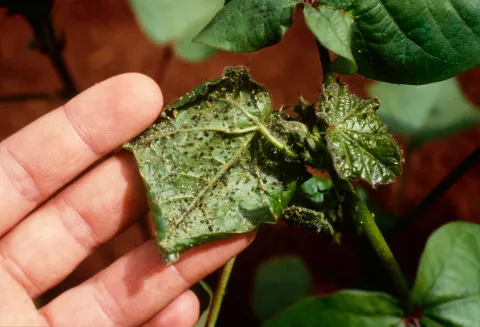
Irregular holes in leaves: Fall armyworm larvae feed voraciously, creating irregular patterns of damage on leaves.
Skeletonized foliage: In severe infestations, leaves may be completely stripped, leaving only the veins.
Damage to crop ears or fruits: In crops like corn, fall armyworms can burrow into the ears, causing significant damage.
Clusters of caterpillars: Fall armyworms often feed in groups, especially in the early stages of infestation.
Window paning: Young larvae may feed on one side of the leaf, leaving a transparent layer that resembles a window.
Whorl damage: In crops like corn, fall armyworms often target the whorl, causing distinctive damage patterns.
Silk clipping: In corn, larvae may feed on silks, potentially interfering with pollination.
Stunted plant growth: Severe infestations can lead to overall plant stress and reduced growth.
Ragged leaf edges: As larvae grow larger, they consume entire leaf sections, leaving ragged edges.
Preventing fall armyworm infestations is always more cost-effective than treatment. Currently no country with fall armyworm has managed to entirely eradicate the pest. However, the following strategies can be useful as preventative strategies:
• Many regions around the world use early warning systems and regular scouting
• Practice crop rotation
• Encourage natural predators through habitat management
• Make the most of resistant crop varieties when available
• Invest in preventive seed treatments
• Use pheromone traps for monitoring pest populations
The best time to intervene is early, when fall armyworm are small and feeding is first detected. Small larvae are easier to control, cause far less crop loss, and are less protected inside maize whorls, rolled leaves or ears.
Understanding the fall armyworm lifecycle and behavior is crucial for effective management. The life cycle of the fall armyworm consists of four stages:
Recognizing these stages and understanding the pest's behavior is extremely important for implementing timely and effective fall armyworm treatment and prevention strategies.
Recognizing these stages and understanding the pest's behavior is extremely important for implementing timely and effective fall armyworm treatment and prevention strategies.
| Fall armyworm life stage | Key targeted areas | Best methods |
| Egg | Scout the underside of leaves | Where practical, remove by hand. |
| Small larva | Plant whorls and emerging tassels | This is an ideal treatment window. Scouting should confirm the presence of fresh feeding and then treat with a selective approved insecticide or biological control option. |
| Large larva | Often spotted at common feeding sites (rolled leaves, whorls or ears) and can be tracked by the damage they leave behind | Reassess whether additional spraying is needed and retreat if necessary as well as take the steps needed to minimize resistance risks. |
| Pupa | Can be left in the soil or in crop debris post-harvest | Foliar insecticides may be useful. After harvest, manage the availability of host species; use crop rotation, sanitation and cultivation where agronomically appropriate. |
| Adult | Use pheromone traps and pay close to regional and national alerts about pest movements | Pheromone traps are useful indicators for when field scouting is crucial but shouldn't be relied upon as a guide for spraying – use trapped adults as a signal to spot damaging larvae in the field. |
Different crops require tailored approaches across biological and chemical practices for effective fall armyworm management. Here are some recommendations for the most at-risk crops.
For more detailed recommendations consult a local agronomist, field advisor or Syngenta representative.
Corn is grown world-wide and is particularly vulnerable to fall armyworm infestations. Effective treatments include:
Cotton can require a nuanced approach to fall armyworm treatment and regular observation is crucial:
Fall armyworm treatment in soya requires a multi-faceted approach:
Fall armyworm control works best when treatment reaches small, actively feeding larvae and is paired with good scouting.
Factors that most affect control efficacy:
Fall armyworm early in development are substantially easier to control. Large larvae consume more tissue, may be more tolerant of many treatments and shelter deep in whorls, rolled leaves and ears.
Treating based only on moth-trap captures is unreliable. Traps offer an indication of risk in the region, but don’t inform you about larval density or crop damage.
Sufficient water volume, nozzle choice, travel speed and directing spray into the maize whorl are all important for ensuring high-quality applications and effective results.
Rain soon after spraying can reduce deposits; heat, wind and low humidity can increase drift or evaporation. Follow the product label’s weather instructions.
Late treatment may kill larvae but cannot restore lost leaf area or prevent quality damage once larvae are in ears.
Use only locally authorized products, at the labelled rate, and rotate insecticide mode-of-action groups rather than repeatedly using the same group.
Re-scout approximately three to five days after treatment, or according to the product label and local advisory guidance. Look for live, small larvae and fresh feeding not simply the old leaf damage, which will remain visible after larvae are controlled. Check multiple areas of the field, including previously infested hotspots. If the surviving larvae are large, it is prudent to confirm application coverage and identification before assuming the presence of a resistant population or repeating treatment.
According to the Insecticide Resistance Action Commitee (IRAC), fall armyworm has documented resistance to multiple insecticide classes.
Resistance patterns are highly regional and can differ between the insect’s genetically distinct host-associated populations.
Resistance should only be suspected where a correctly applied, labelled product repeatedly fails against the intended small larval stage, then investigated through local extension, plant-protection or resistance-monitoring channels.
In addition, resistance to several Bt proteins has been documented in some populations, so Bt traits are not a standalone solution where resistance is already known.
However, that does not mean every poor result is resistance. The more common culprits are late application, inadequate coverage, rain after treatment, incorrect dose, or larvae that had already moved into protected sites.
Syngenta scientists are researching the development of new modes of action for Bt proteins. You can find out more about this work in our interview with Dr. Hynsook Chae who leads ongoing research focusing on trait development. As she explains, it is important to “push forward new traits as quickly as possible – if we can speed things up by even one year, we can get better traits to farmers more quickly, protecting their harvests for the long term.”

Local regulations and approvals will determine which products are available in your region but Syngenta’s powerful and effective solutions to fall armyworm include:
Find out more about our disease management solutions in your region
FAQ
Some tips on controlling fall armyworm while protecting beneficial insects include:
There is no fixed interval. In warm, frost-free regions, fall armyworm may be present throughout the year, with several overlapping generations.
In seasonal or temperate climates, outbreaks commonly occur from late spring through autumn, following migration and favorable warm weather.
For any farm, the most useful knowledge comes from local trap networks, weather conditions, and crop stage, not a calendar date alone.
Fall armyworm does not normally survive sustained freezing conditions. It overwinters only in warm, frost-free areas, then adult moths migrate into cooler regions during the growing season.
In the UK and much of northern Europe, outdoor overwintering is not generally expected; detections would be managed through plant-health surveillance rather than assumed to establish a permanent seasonal population.
Other pests called “armyworms” can differ. For example, some true armyworm species overwinter locally depending on species and climate.
Some natural enemies of the fall armyworm include:
These can suppress populations, particularly when broad-spectrum insecticides are not disrupting them, but they rarely guarantee control during a fast-moving outbreak, but they are a crucial part of keeping routine infestations below damaging levels.
You might also be interested in
Stay informed
Receive Syngenta press releases directly per email