

From a molecule to a farm
The science of making crop protection work for a billion-dollar problem
Inside Syngenta's labs in Greensboro, North Carolina, where a new active ingredient was built into a unique formulation to combat the corn rootworm, the biggest threat faced by American farmers.
On a Tuesday morning in Greensboro, Elijah Meck, Technical Product Lead at Syngenta, is thinking about an immature beetle. Not a beetle in a lab or under glass, but one in the soil of an Illinois cornfield, feeding on roots in a crop a farmer has spent months tending.
The larvae of this beetle feed underground on corn roots and, by the time growers see their corn begin to lean and topple, the root system that should have anchored it is already gone.
“The industry calls it the billion-dollar pest. And that tells you something. It's not just a pest problem. It's an economic problem,” says Elijah.
Corn rootworm larvae in hand. Credit: Purdue University
Corn rootworm larvae in hand. Credit: Purdue University
For more than a decade, the US team has been part of the effort to bring a new insecticide to American farms. The team works out of Syngenta's North American Crop Protection headquarters in Greensboro, NC, a campus that opened a new building in late 2024, with 220,000 square feet of lab and office space, the latest addition to a site Syngenta has been based at since the mid-1960s.
The Greensboro site plays a key role in adapting global innovation for regional needs—ensuring solutions perform under the specific conditions faced by US farmers. Inside, scientists do work that most people outside agriculture rarely think about. This is where new chemistry meets the American farm.
Getting to a unique formulation
In 2009, Syngenta’s scientists at Stein, Switzerland, discovered new active ingredient, the cornerstone compound in a product that makes it work. It then made its way across the Atlantic to Greensboro, where researchers began field testing the active ingredient in 2013. It was launched as PLINAZOLIN® technology in 2025.
An active ingredient alone isn’t enough—it has to be turned into a product farmers can actually use. Before it can be used on a farm, it has to become a formulation, the finished product that blends the active ingredient with materials that keep it stable, pourable, and effective in the field. Going from one molecule to multiple products, each of which solves a problem for North American farmers, is the work that happens in Greensboro.
This means testing them across various crops in 40 states, in different climates and soil types, so that it works everywhere: in the fertilizer tanks mounted to corn planters moving through the Midwest at planting time, in the fields of Mississippi at the height of summer, and in deserts of Arizona in the winter.
A molecule that controls many pests across many crops cannot reach all of them through a single product, because growers have different needs. For instance, one grower may need foliar applications while another grower might be looking for seed treatments. So, the same active ingredient had to be built into formulations designed for each use case.
“We have multiple formulations, each of which was designed for specific markets throughout the US,” says Kevin Langdon, Technical Product Lead for soil PLINAZOLIN technology brands.
Corn growers in the US have a particular technique. "When growers are planting," Langdon explains, "they want to put a liquid fertilizer in the furrow. The ideal formulation needs to go right into a fertilizer tank and be compatible with all kinds of different fertilizers. That's unique to the US market."
A formulation must strike a careful balance. Too thick, and it is difficult to pour. Too thin, and the active ingredient can separate and settle to the bottom, where, in a large container, it becomes nearly impossible to mix back in. The product has to stay clear and free of clumps, or it cannot be sprayed at all. Getting a farmer the right dose, evenly, depends on solving these types of challenges.
This led to a unique formulation for the North American market: Opello, a soil-applied insecticide that controls the destructive corn rootworm. “Opello can be tank mixed with fertilizer, and that brings top-end efficacy against corn rootworm. This product is compatible with a wide breadth of starter fertilizers and combinations thereof,” says Langdon.
To get the compatibility the formulation needed, including with fertilizers, the team worked through more than a hundred ingredients across 70 variants.
“Building fertilizer compatibility into Opello was a big win for us. This was an unmet need for growers, and we were able to deliver on that,” says Andrew Pearson, Head of Product Technology & Engineering, North America.
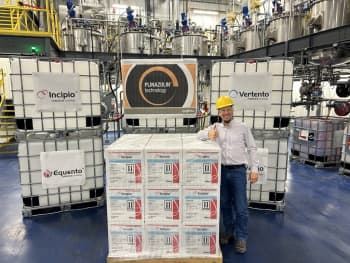

Andrew Pearson, Head of Product Technology & Engineering (PT&E), North America.
Andrew Pearson, Head of Product Technology & Engineering (PT&E), North America.

Ram Ramalingam, Group Leader for Product Technology & Engineering (PT&E) Application Technology at the Greensboro, NC site with the Tank Mix Compatibility robot (ATLAS) shown in the background.
Ram Ramalingam, Group Leader for Product Technology & Engineering (PT&E) Application Technology at the Greensboro, NC site with the Tank Mix Compatibility robot (ATLAS) shown in the background.
What happens in the labs
Andrew’s Greensboro-based team, which is part of R&D, develops the formulations and packaging, methodology to analyze product quality, and the process for manufacturing product at scale. They also stress-test the products to ensure their performance is unaffected after shipment and storage in various conditions.

Between the factory and the field, a product must survive a long journey. It is manufactured, trucked across the country, stored in a warehouse through a frigid winter or a scorching summer, and then finally poured into a tank on a morning when the conditions are right.
Each of those stages is a chance for a formulation to fail in various ways: to separate, to crystallize, to thicken into something that won't pour. So, the team simulates the whole journey, then checks to confirm if the product quality has degraded, such as measuring how the product pours from the package and dilutes in a spray tank.
Andrew’s team develops tests to simulate the conditions a product might encounter from manufacture to use on the farm. Inside the Greensboro labs, that means recreating the full range of American weather, from 0 to 122 degrees Fahrenheit, or minus 18 to 50 Celsius.
"We look at different temperatures, very cold to very hot," Andrew says. "We look at different humidities for some tests. We look at static versus dynamic, sitting still versus vibrating or shaking. So, for example, to mimic shipping versus a package sitting on a shelf. And we look at combinations of these, like shipping a hot product."
The team has recently launched ATLAS, short for Application Technology Laboratory Automation System. It is a custom-built robot that does at scale what a chemist once did by hand: testing how products behave when they are mixed together in a tank.
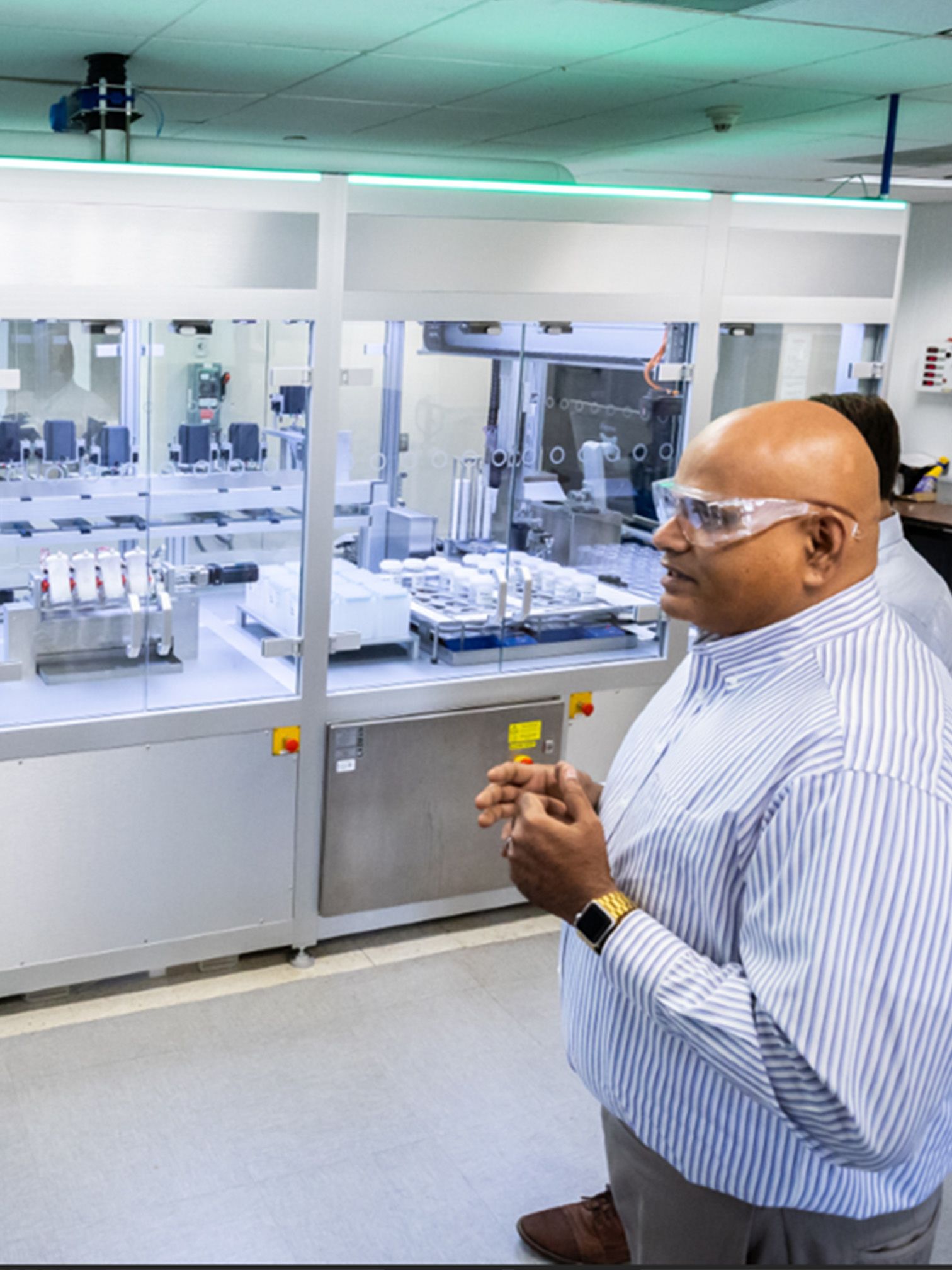
ATLAS runs mixtures through the full sequence, sample preparation, mixing, imagery, and analysis, working methodically through the questions that decide whether a formulation holds up in the real world. Does the tank mixture settle out and leave sediment? Will it plug a nozzle? Does the order in which products are added change the outcome?
Every test result feeds a database built over years; one the team can return to whenever a grower calls with questions. The historical data lets them provide quick answers, proof that Syngenta products have been put through real-world lab testing scenarios before reaching growers in the field.
Broad-spectrum formulas
Opello is only one example. What makes PLINAZOLIN technology significant is its broad spectrum. It works across multiple crops and pests, from plant bugs in cotton to Colorado potato beetle in potatoes to the diamondback moth in vegetables. That range is the reason the active ingredient had to become several products.
"The existing chemistry is less effective," Elijah says. "When you expose insects over and over to the same thing because there's not been a lot of new things to come in, the selection pressure is high, you start to see performance slip because resistance starts to build. It's really important to the grower for new innovation, new modes of action, to be able to manage those pests."
A new mode of action is what PLINAZOLIN technology offered, and the more the US team tested it, the more uses they found." As we started getting into the biology work, we started learning more," Elijah says. "It's like, well, if it works on this pest, it's possible it works on that pest."
Building together
PLINAZOLIN-based formulations for the US market are in their launch year. Incipio, the foliar product for vegetables, has gone out in markets in Arizona as well as Florida and Georgia. Opello has reached growers too.
What ties all the research and testing together is the location: the labs in Greensboro. Andrew's scientists sit alongside marketing, field research, and product safety personnel. "We collaborate across the other R&D, marketing and other teams onsite, receive feedback on our product performance, and work together to iterate concepts that can turn into industry-leading products,” he says.
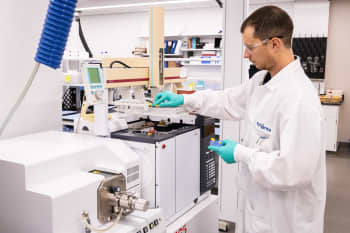
Melanie Reardon, Leading Technician in the Product Technology & Engineering (PT&E) Analytical Department at the Greensboro, NC site.
Melanie Reardon, Leading Technician in the Product Technology & Engineering (PT&E) Analytical Department at the Greensboro, NC site.
Prior to 2024, the R&D teams worked in separate buildings from marketing and other functions; now it is common to see people from marketing and other R&D functions interacting in the labs. From formulation and packaging design and development to stability and robustness testing, it all happens under one roof.
"There is a true grower need for something new and different in how we work together to bring new products to our customers. Syngenta is showing world-class leadership in collaborating and helping growers have solutions for their challenges,” Andrew says.
Get an inside look at how our world-class laboratories are tailoring global innovation to meet regional needs.
