Making sense of soil.
How data fusion is guiding precision agriculture
With better sensing, imagery and more information than ever, here’s how data experts are unlocking actionable insights for farmers.
Farmers today have more data about their land than any generation before them. Irrigation sensors track soil moisture by the hour. Equipment logs every pass across a field meter by meter. Satellites and remote sensing add a layer of visibility that simply didn't exist a decade ago. Information, once scarce on the farm, is now everywhere. But one of the challenges farmers face is what to do with it.
As Harold Yin, Project Implementation Lead for Syngenta explains: “A lot of advanced growers were telling us, we've got all this precision ag equipment that's getting better and better, but we don't necessarily have the right way to feed it or make use of it in the best way."
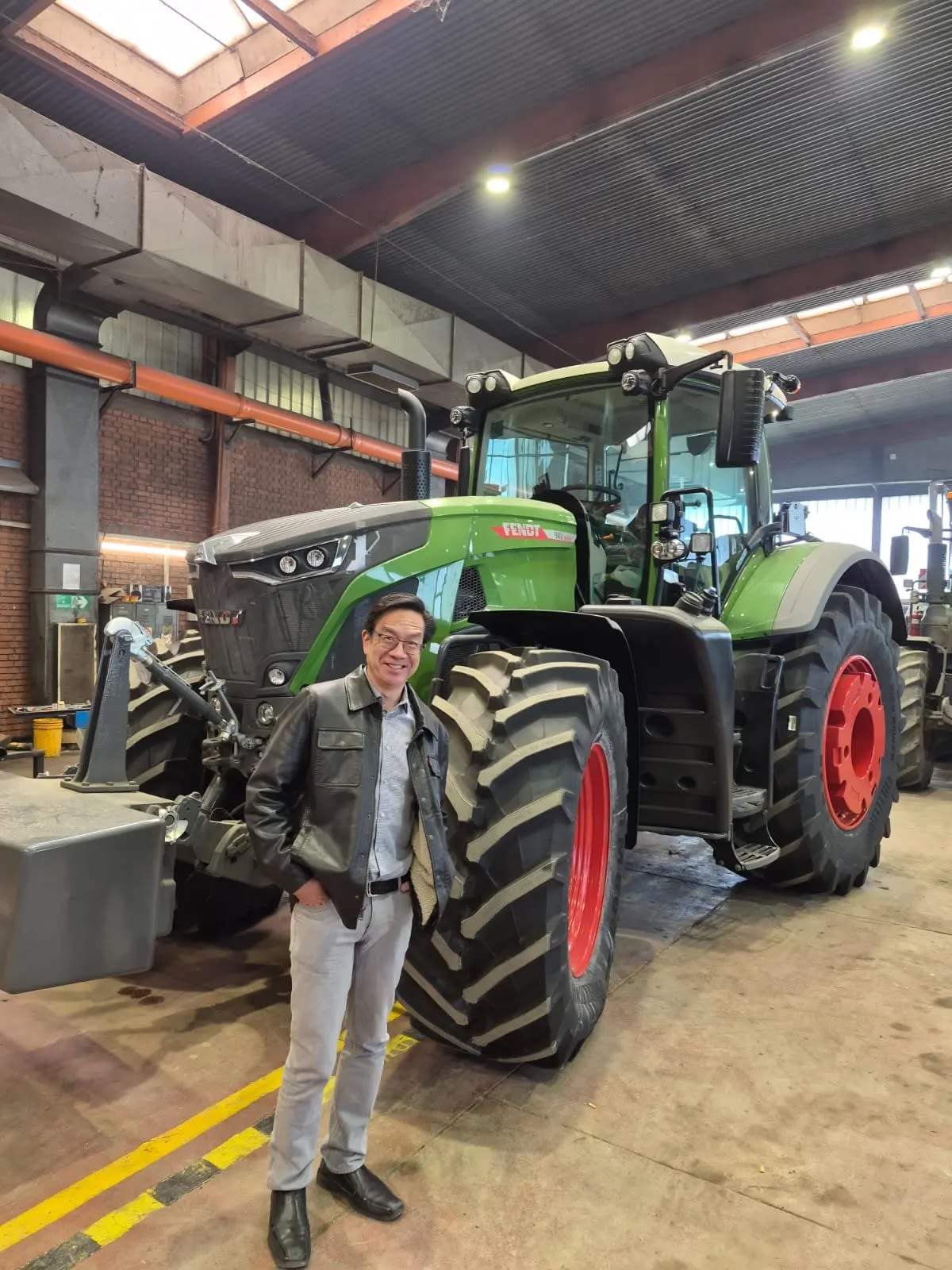
To solve this, Harold along with experts across the world, have been working to develop a solution that they call the soil clinic. This project aims to do two key things. First: help farmers improve the quality of their soil, and secondly, provide robust recommendations to help farmers raise their productivity at the same time.

Harold Yin, Project Implementation Lead, Syngenta.
Harold Yin, Project Implementation Lead, Syngenta.
Layers of data
To do this effectively means working with data - collected alongside the farmers who remain in complete control of their proprietary information. Here’s how the process unfolds.
Everything starts with soil sampling, but this can often be time intensive. Saïd Kharbouche, Senior Data Scientist at Syngenta, explains how the team make things more efficient: "Instead of doing grid sampling, we suggest where to go and collect the data.”
Soil sampling
Soil sampling
Advanced algorithms identify the best locations in a field, and the results from those samples are used to train artificial intelligence (AI) models that create detailed maps for a field across different soil properties, ranging from key nutrients and pH to organic matter and carbon.
These maps are then analysed with various geostatistical techniques to produce a tailored set of soil health prescriptions.
Saïd points out this involves handling large amounts of complex information– thousands of data points which are compressed into a detailed, actionable data set. “The grower doesn't need this kind of soil mapping just to have a map. They need this to take action - how can they improve yield while also maintaining or improving their sustainability?"
So, by bringing together all these layers of information, from the microscopic nutrients found in soil sampling all the way up to thousands of satellite images and on-farm data gathered over many seasons, new insights can emerge that lead to reliable recommendations.
Recommendations and a change narrative
Harold says: “When we look at yield performance, modern harvesting equipment can now measure yield at very small increments as the harvester goes across the field. So, we know exactly what the variation of yield looks like year over year and where in the field changes might be happening.”
When this kind of information meets machine learning farmers can start to spot patterns, not just from season to season but within different areas of a single field. Harold says: “You can start extracting interesting insights into why yield is either overperforming or, more likely, underperforming.”
Through this process of data fusion, farmers can be provided with everything from variable-rate prescription maps for herbicides to seeding, nutrients, tillage recommendations, and biological products.
Harold explains that the prescriptions are only a part of what growers get. Each one arrives with an AI-powered narrative that unpacks the reasoning behind the prescription, and a suggested order of priority so growers know which actions to tackle first.
"Often you just get maps of prescriptions. But it's the narrative that ties it all together. It'll tell a farmer, 'Here's a field where your groundwater has more mercury than it should. Until you mitigate that, you don't want your roots growing too deep.' From there, we can suggest the right tools, and set limits on practices like root depth, based on that narrative and the performance the farmer is aiming for."
Built by experts, hand in hand with farmers
Doron Gal, Head of Digital Sustainability and Soil Health, says this represents a massive technical challenge. “It’s taken many years of work to get to this point. Soils are ecosystems with physical, chemical, and biological components that are highly sensitive to their environment and incredibly difficult to model. It is heterogeneous at every scale; you can solve a problem in one field, but a few meters away the solution no longer works.”
Doron Gal Head of Digital Sustainability and Soil Health, Syngenta.
Doron Gal Head of Digital Sustainability and Soil Health, Syngenta.
Built by experts, hand in hand with farmers
Doron Gal, Head of Digital Sustainability and Soil Health, says this represents a massive technical challenge. “It’s taken many years of work to get to this point. Soils are ecosystems with physical, chemical, and biological components that are highly sensitive to their environment and incredibly difficult to model. It is heterogeneous at every scale; you can solve a problem in one field, but a few meters away the solution no longer works.”

Doron Gal Head of Digital Sustainability and Soil Health, Syngenta.
Doron Gal Head of Digital Sustainability and Soil Health, Syngenta.
Matt Wallenstein is Syngenta’s Chief Soil Scientist and along with an international team of researchers has just published new research on the vital task of predicting and preventing degradation of cropland productivity due to soil salinization.
Matt says: “Soils contain multitudes of information that could unlock agricultural productivity and sustainability. Until now, it’s been prohibitively expensive and difficult to measure what matters to farmers at the spatial resolution they manage their farms at. Now we’re helping to solve that problem, giving farmers new actionable insights into how to optimize their inputs and management. I’m excited to see the promise of AI-enabled agriculture being realized through this project.”
Bringing this to life means working with farmers on the ground.
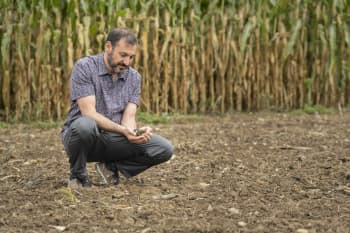
Catriel Pedernera is a Syngenta Digital expert in Argentina who has been working with local farmers on the soil clinic project for the last three years.
“The farmers here in Argentina who own their land are very concerned about soil health. They want to continue farming over many years and seasons, and they want to do it sustainably and profitably. We said: with the right information we can give you very good advice. "
"We co-created this project with them. It was their land, their machines and their time. Our goal is to help them continue farming over the years in a sustainable way.”
Farmer checking soil health in his field.
Farmer checking soil health in his field.
A mutual back and forth conversation helped the team refine the entire process. “We would give recommendations and they would give us feedback, every year we changed and improved the way we gave recommendations,” explains Catriel.
This iterative process was essential – after all, advice is nothing without trust. Catriel says: “The first step was that farmers needed to believe in our recommendations. Sometimes, when you give farmers a new digital tool, they are sceptical.”
After three years of on-the-ground co-creation, results speak for themselves. “The farmers who have worked with us now believe in it because we showed them our reports, our work and our advice, and they have already improved results on their farms. It’s very rewarding to help farmers make better decisions with real data taken in the field.”
