

Meet the Fellows - the scientists solving agriculture's hardest problems
Within Syngenta a community of scientists brings their leading expertise to some of agriculture’s most complex challenges.
New innovations in agriculture are always urgently needed. Farmers constantly face challenges, from emerging pests and new diseases to changing conditions that necessitate more resilient, high yielding seeds. But innovation isn’t a speedy process. Indeed, research for CropLife International shows that developing a new crop protection technology takes more than 10 years and can have a price tag that runs into hundreds of millions of dollars.
Innovation takes time, and more importantly, takes expertise. Across the world Syngenta has R&D teams made up of thousands of scientists, technicians and experts, but among them is a far smaller group of scientific leaders. These are the Syngenta Fellows – a global community of leading scientists, researchers, and technologists with a proven track record of sustained technical achievement and innovation.
Candidates wanting to become Fellows must have a background of delivering significant innovations before being nominated by their manager, considered by a panel of Fellows, and appointed by the Heads of R&D.
Catching the innovation train
Aurelien Bigot is a Syngenta Fellow in Biologicals R&D. He says: “The way I describe the Fellows is that our role is to help the company catch the train of innovation in advance. We need to take the early train: identify opportunities and maintain a strong connection with the outside world.”
It’s this willingness to take on new opportunities that led Aurelien to move from a scientific background as a synthetic chemist to the newer technologies of biologicals – products derived from or inspired by naturally occurring components.
Explaining what prompted this shift, he says: "I began looking at alternative technologies, including peptides and proteins. Getting hands-on with a specific project pushed me to think about alternative modalities: technologies with a sustainability and value proposition different from synthetic chemistry.“
But new technologies also carry with them new scientific challenges that have to be overcome. Aurelien says: “In synthetic chemistry research, optimizing for performance alone would be relatively straightforward. The real challenge is to discover molecules that are not only cost-effective but also safe for people, the environment and ultimately accepted by society. With peptides, proteins and other biologicals the situation is almost the reverse. Safety and public perception are more easily addressed, but we must make sure these innovations are highly effective in the field, can scale widely and have an affordable cost of goods. This is the central challenge and represents an amazing opportunity to keep learning.”
For Aurelien, work as a Syngenta Fellow means embracing new opportunities, even if they end up going in unexpected directions.
“I sometimes worry that I am losing my expertise in synthetic chemistry, because younger scientists entering the field know so much more about recent advances. But I have tried to catch other trains. It has been humbling to realise how much there is to learn. I may never be the expert in these new spaces, but I still hope I can make an impact.”
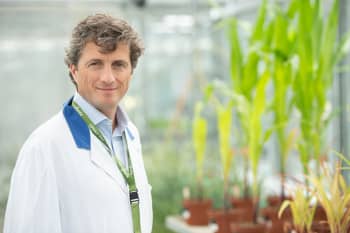
Working on the really big problems
Liz McInnes, Syngenta’s Chief Pathologist, also shows that being a Fellow doesn’t depend on having a typical agricultural background or typical career path.
She says: “By training I am a veterinary pathologist. I work on animal studies which are required by regulators to accept our compounds. My day job is examining tissue slides from those studies, but I also work on finding ways to reduce the need for animal testing.”
Even within areas that are heavily regulated there is still important research to be done. As Liz says: “I am very interested in reducing animal studies through new approach methodologies, or NAMs. These use cells in vitro as alternatives to animal studies.”
For Liz, the purpose of being a Fellow is to tackle long-term scientific challenges. She says: “We take on intractable problems, such as reducing animal testing. Everyone agrees it would be good to reduce it, but regulators in different countries continue to request it. So, if somebody is developing a non-animal model, I often become involved. We compare results and ask: Is it robust? Is it what regulators want, and are they likely to endorse it?”
Taking on long-term challenges requires a particular mindset too, she adds: “We get to help with the really big problems: the difficult ones, the ones other people cannot solve, do not want to solve, or get put in the “too-hard basket”. I think the type of person attracted to becoming a Fellow relishes problems like that.”
Thirty years of expertise
Michel de Lange is a Syngenta Fellow and Trait Development Lead based in Enkhuizen in the Netherlands and has more than three decades of experience in improving the genetics of vegetables to help protect plants from disease.
Michel De Lange has 30 years of experience in building plants' genetic resistance to dangerous pathogens.
Michel De Lange has 30 years of experience in building plants' genetic resistance to dangerous pathogens.
Michel says: “Most of my career has been spent in resistance breeding. For the last 15 years or so, I have been battling downy mildew in lettuce and spinach. In lettuce, it is a pathogen called Bremia, in spinach, Peronospora. Both are oomycetes, not technically fungi, though it looks a little like that.”
Bremia is a destructive pathogen that requires constant innovation in breeding to ensure plant genetics can maintain their resistance.
Bremia is a destructive pathogen that requires constant innovation in breeding to ensure plant genetics can maintain their resistance.
Protecting these delicate crops means making sure they have resistance at the genetic level, but with a pathogen like downy mildew this is an ongoing challenge. Michel says: “It can adapt very quickly. As an industry, we bring resistance to market, but a typical resistance gene may not survive for very long because the pathogen adapts and breaks that resistance. Then you need to come up with something new.”
Michel says: “The work is interesting, but also stressful. Every day, there is the question of whether your varieties will stay in the market.”
So one of the important aspects of the Fellows’ role is helping lead research that enables the crop to stay one step ahead of the disease.
Michel adds: “You must prepare for something now that is going to happen in the future. You can have a gene that works today and protects against all the variants we know. But if that is broken tomorrow and you have no alternative, you have a huge problem.”
This means that a pipeline of potential new genes is necessary to keep the varieties that farmers depend on available.
As Michel explains: “If you go to the grocery store and buy lettuce every week, it may be a different variety each time. They may all look the same, but genetically they are very different.”
From left to right: Michel de Lange with colleagues Jeremie Lecoeur, Rakesh Kumar and Jesus Abad.
From left to right: Michel de Lange with colleagues Jeremie Lecoeur, Rakesh Kumar and Jesus Abad.
For Michel, the great advantage of being a Fellow is that it allows for the time to take on the complex, ever evolving challenges of protecting crops from these pathogens.
“When I was appointed a Fellow, I was really proud. It was not easy to become a Fellow, especially with my background. Traditionally, people who want to get higher in the organisation become leaders, lead people and have less time to do science. The important part is that you can keep doing science.”
The joy of unprecedented challenges
Tharacad Ramanarayanan is another Fellow who brings years of experience to some of the biggest challenges in agriculture.
“My primary training is in agricultural engineering, and my early expertise was the predictive modelling of natural systems," says Tharacad. "I worked on ways to model problems like pesticides entering rivers and lakes through runoff and drift.”
Syngenta Fellow, Tharacad Ramanarayanan expertise is in predictive modelling, a vital area of science to help contemporary agriculture work more safely and sustainably.
Syngenta Fellow, Tharacad Ramanarayanan expertise is in predictive modelling, a vital area of science to help contemporary agriculture work more safely and sustainably.
This kind of risk assessment and product safety work is a key part of keeping agriculture safe and productive.
“In 2013, I joined Syngenta to lead the human risk assessment team. I was pleased that I kept science as part of my role, rather than moving entirely into people management. I became a Fellow in 2023. Preparing the case for becoming a Syngenta Fellow meant putting together your scientific life story and defending your position as a scientific thinker. It felt like a very significant threshold.”
And meeting that threshold has had a transformative impact on what a typical day might look like. He says: “Now I work more on science strategy: identifying new ways of working, spotting information gaps, and ways to fill them. I am also brought into issues that are outside the mainstream, where there is no guidance or even precedent. The most pressing question is always: how do we establish that something is safe?”
For Tharacad, the role of the Fellows is multifaceted, encompassing both mentoring the next generation of scientific leaders and offering best-in-class technical advice.
The Syngenta Fellows work across a range of scientific fields, helping lead the search for innovative solutions to complex scientific problems.
The Syngenta Fellows work across a range of scientific fields, helping lead the search for innovative solutions to complex scientific problems.
“We have excellent scientists who need to see a path to grow as science leaders, not only as people leaders. That gives people a way to satisfy their aspirations to do good science. After all, leaders and managers cannot be experts in everything. They need a trusted core of people who can advise on technical questions. The Fellow pathway is demanding, and the trust comes from one’s experience and what one has done.”
This combination of responsibility and challenges leads to immense job satisfaction, says Tharacad: “It gives joy. Not many people relish it, because you do not know what is out there and what you come up with may or may not work. But that is the challenge.”
A community of excellence
Across the entirety of the Fellows community there is a range of different topics and areas of specialization, but what unites them is a combination of deep expertise and the freedom to investigate the most pressing problems.
The Fellows’ work may rarely offer instant or straightforward answers, but it creates the conditions for lasting progress: stronger crops, safer approaches and new possibilities for farmers facing an uncertain future.
Syngenta recognizes our scientists' achievements and celebrates the breakthroughs that emerge from their work through the Science and Technology (S&T) Prize. As pioneering experts in their scientific disciplines, the S&T Prize is judged and awarded every year by the Syngenta Fellows. Investing in exceptional talent and celebrating innovation is one of the reasons we have been recognized as agriculture's leading employer by Science Magazine for the last 10 years in a row.
By giving experienced scientists the space to keep asking difficult questions, Syngenta is investing in the curiosity, rigour and perseverance necessary to keep bringing breakthroughs to farmers across every scientific field.
