

Ensuring fruits and vegetables can withstand the rigors of transcontinental supply chains
Cucurbits carry most of their weight in water, which makes them delicious and fragile in equal measure. Syngenta's breeding program is rewriting that equation, making them more durable to withstand the journey from field to table.
Somewhere on a dirt track outside Mataranka, in Australia's Northern Territory, a truck loaded with melons is about to hit a rough patch.
It's the kind of trip familiar to Rombola Family Farms, one of Australia's largest melon operations, running a counter-seasonal program out of Mataranka that keeps fruit moving to market year-round. This truck, or one just like it, will hit several more potholes before the fruit reaches a packing shed.
Terrain throughout Australia's Northern Territory can vary from smooth-surface roads to tricky dirt tracks. Photo by Rachel Claire.
Terrain throughout Australia's Northern Territory can vary from smooth-surface roads to tricky dirt tracks. Photo by Rachel Claire.
“Northern Territory melons are picked, packed, and transported 3,500 kilometers to the markets, retail stores, and exported to Japan and Singapore,” says Cindy Ting, Pack House Manager, Rombola Farms.
Most melons were never built for that kind of trip. Their flesh is soft, their sugar content is unstable once picked, and their skin offers little protection against the small, relentless jolts of a journey that has nothing to do with how well the fruit actually grew. To better support melons on such journeys, Syngenta's breeders decided to change that math. The story of how they did it starts not in a field, but in a map of shipping routes.
Where transport decides who gets the produce
Melon has become one of the more well-traveled items in the produce aisle. Winter melon sold in the United States mostly comes from Guatemala, Honduras, and Mexico. Brazil ships melon into Europe during its own off-season, filling the gap while European growers wait out the cold. A shipment moving from Latin America to Europe can spend 72 hours sealed inside a shipping container.
That volume of movement works because the infrastructure behind it — refrigerated trucking, paved highways, port logistics built up over decades — is strong enough to carry it.
In the US, farm-level losses of fresh produce vary by crop, with studies reporting losses ranging from low single digits to more than 20 percent. But in countries without comparable roads, cold storage, and packing infrastructure, more than half of the produce can be lost.
For instance, India loses roughly 40 million tons of fruit and vegetables a year, worth an estimated $18 billion, largely to gaps in the cold chain and weak transport links between farm and market. Across Sub-Saharan Africa, nearly 45 percent of fruits and vegetables are discarded or wasted before they ever reach a consumer.
The Heidi melon is a long-shelf-life melon which launched in 2021.
The Heidi melon is a long-shelf-life melon which launched in 2021.
None of this is abstract for the people growing the food. Losses like these can reduce incomes for millions of smallholder growers worldwide losing a meaningful share of their livelihood to a bad road and a fruit that couldn't survive it.
This makes transportability breeding more than a shelf-life convenience. In a market with excellent infrastructure, a soft melon is a quality complaint. In a market without it, a soft melon is a farmer's income disappearing between the field and the first buyer. A breeding program built for the road has to work for both.
Doing things differently
One variety carrying the weight of that challenge is Heidi, a long-shelf-life melon that has become a benchmark for how far produce can travel and still taste like it was picked yesterday. Its resilience comes from several traits working together.
It typically takes a decade of research to develop a new variety like Heidi, which launched in 2021.
Rakesh Kumar, Syngenta Science Fellow and Breeding Team Lead (left) with Ashish Patel, Syngenta’s Head of Germplasm Development for Cucurbits, at Future of Veg event in Woodland, California.
Rakesh Kumar, Syngenta Science Fellow and Breeding Team Lead (left) with Ashish Patel, Syngenta’s Head of Germplasm Development for Cucurbits, at Future of Veg event in Woodland, California.
“Melons are bred for traits that let the fruit withstand long-distance shipping, high post-harvest shelf life, sugar stability, firm flesh, and resistance to rotting and discoloration,” says Rakesh Kumar, Syngenta Science Fellow and Breeding Team Lead.
Low ethylene production was the starting point for Rakesh, slowing the chemical process that softens flesh once a melon is separated from the vine.
Firmness came next. "Ideally, we maintain flesh firmness of six to eight pounds so that melon flesh doesn't break down during transport," Kumar says, enough resistance to survive a bumpy transfer from field to packing shed.
Heidi melon has become a benchmark for how far produce can travel and still taste fresh.
Heidi melon has become a benchmark for how far produce can travel and still taste fresh.
Field-holding ability matters just as much. “It means the melon can withstand environmental fluctuations and varied agronomic practices,” Kumar says. “They are less prone to cracking or rotting during transport.”
This gives growers room to make decisions on their own timeline instead of racing a fragile crop to the truck. And because sugar accumulation in Heidi stays stable even as it moves through shoulder-season growing conditions in Northern Australia, Mexico, and South Africa, warm to cool and back again, the flavor a breeder worked toward is roughly the flavor a customer gets, no matter how many borders the fruit crossed.
Then there's the rind itself. “Fruit netting is cork-like suberized tissue on the fruit rind which acts as a shock absorber and maintains the structural integrity of fruit,” Kumar says. “It comes in very handy against vibrations when fruit is transported on bumpy roads from the field.”
Growers put it to the test
“The flesh is always firm and picked before stem separation while still maintaining good sugars,” says Justin Martin, a Syngenta Sales Specialist in Northern Australia. “Heidi generally is an easy variety to grow for most farmers due to consistency with yield, good netting coverage, range of size, and consistent maturity indicators.”
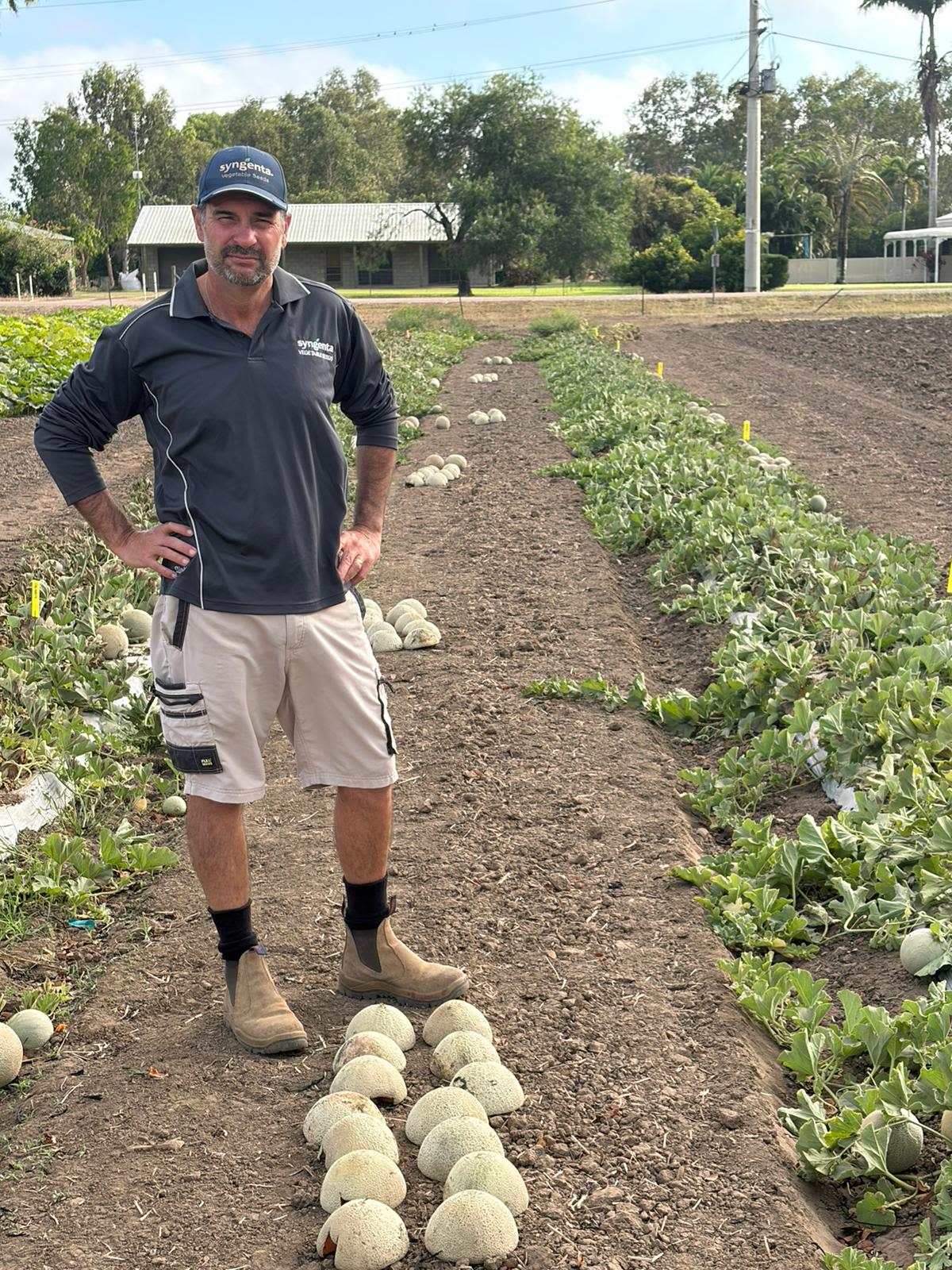
That ease of growing has made Heidi a fixture for Rombola, a farm with more than 50 years in the business in New South Wales, the Northern Territory, and Queensland. The company has kept expanding its Territory footprint in the Douglas Daly region, a stretch of land with a long history of producing excellent watermelon. It's out of that pipeline that Cindy has watched Heidi prove itself.
“Heidi is one of the best performing melons for shelf life, up to 21 days,” Cindy says.
Meanwhile in Hermosillo, Mexico, the same variety is solving a different version of the same problem. Videxport, a major agricultural company that has been growing and exporting produce out of Sonora since 1975, farming more than 3,000 hectares of watermelon, table grapes, and bell peppers under certifications like PrimusGFS and Fair Trade. Much of it is destined for the US, Canada, and the UK. For Carlos Ochoa, Production Manager at Videxport, Heidi earns its place because it doesn't force a choice between markets.
“Heidi meets demand in both export and import markets due to its high quality and firm flesh,” Carlos says. “It is shipped to both export and domestic markets, which require long-distance overland transport.”

Justin Martin, Senior Sales Specialist, Northern Veg Seeds, Syngenta Australia.
Justin Martin, Senior Sales Specialist, Northern Veg Seeds, Syngenta Australia.
A trait that runs through the whole family
Melon, though, is only where the story starts. Every crop in the cucurbits family shares the same structural weakness of a body made mostly of water, which is what makes them refreshing but also makes them so easy to damage.
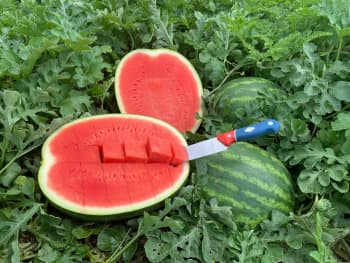
“With melons, small jerks during transport can crack them because of the high water content,” says Ashish Patel, Syngenta’s Head of Germplasm Development for Cucurbits. “Watermelons are even more prone to this.”
The development process for vegetable varieties requires a deep understanding of market needs, based on which Syngenta’s breeders select a mix of plant and fruit characteristics. In Heidi, these are manifested in absorbing the kind of small, repeated impact before it cracks a fruit open from the inside.
Watermelon carries the highest water content of the group, and it feels the transport problem at scale. China alone grows more watermelon than every other country combined, and much of that supply moves by road across provinces before it reaches a city market, hauls that can run well over a thousand kilometers from growing regions to consumption hubs.
Squash faces a different kind of exposure. Unlike melon, it rarely crosses an ocean, each region tends to grow and consume its own type: white squash in North Africa, green squash across Europe, yellow squash in the United States. But domestic distances can still be significant. A shipment moving from a growing region to a distant retailer within the US or Canada can cover nearly 4,000 kilometers, plenty of room for a poorly built fruit to arrive damaged without ever leaving its home continent.
Back on the road
Outside Mataranka, none of the years it took to develop Heidi are visible. There's just a truck, long stretch of rutted roads, and a melon built to take the hit.
What Syngenta's breeders have built into Heidi isn’t a single dramatic trait but an accumulation of small ones: firmness, netting, field-holding ability, sugar stability, each one absorbing a little more of the journey until it reaches its destination.
