

Sunscreen for plants
Helping turf to protect itself during sultry summers
Like us, plants need protection from too much sun. A fusion of science and nature has resulted in a pigment for sports turf which shields grass from harmful UV rays.
As the long, hot summer reaches its peak in the northern hemisphere, people are seeking out shade, eating ice cream and slathering on factor 50.
While sunshine may be good for us and for nature, protection from excessive sunlight is crucial, especially at the height of summer. While we can reach for the sunblock, plants don’t have that option.
Or do they?
Plants wearing sunscreen is more common that you might think – especially for sports turf where grass is cut very short on a daily basis and is therefore less able to withstand protracted exposure to the sun. The intensive management of sports turf coupled with repeated use also stresses the grass, making it more vulnerable to strong light.
A pigment for turf developed by Syngenta, used to deliver a consistent green color, protects golf greens, sports pitches and other playing surfaces from harmful UV rays and intensive light.
Sean Loakes, Turf Technical Europe at Syngenta Professional Solutions (SPS), explains why sunscreen for plants is so important.
“A little bit of light is good for us. It helps us get vitamin D in our skin which is important for healthy bones. But too much and you can’t handle it anymore and you start to get burned. It’s similar with a plant. There’s an upper limit with every different grass species everywhere in the world of what it can handle in a day and what is too much.”
Learning from nature
Like other green plants, grass relies on photosynthesis to survive. By harnessing the energy in sunlight and using it to fuse water and carbon dioxide to form simple sugars, plants gain energy to grow. In simple terms, the cells in the leaves are responsible for absorbing the sunlight. If the DNA of these cells is damaged by too much sunlight, the whole process breaks down.
Normally, plants react naturally to a lot of sun by producing pigments such as carotenoids and anthocyanins to decrease photosynthetic stress. In other words, plants create extra pigments to absorb excessive light, ensuring that the plant remains healthy. But these naturally occurring pigments can take time to develop and only do so much to help. Also, these biological reactions divert resources away from key processes like root growth and fighting disease.
UV protection products can help high-quality sports turf to cope during periods of hot, sunny weather.
UV protection products can help high-quality sports turf to cope during periods of hot, sunny weather.
Using the latest generation of pigment technology, including a green-colored compound with a structure similar to the chlorophyll molecule found in plants, Syngenta’s Ryder® mimics these pigments, maximizing the plant’s ability to photosynthesize while delivering protection against harmful UV rays.
“Our UV protection products essentially help us to mitigate the UV,” says Sean. “The pigment in Ryder® absorbs some of the UV light and reflects some of that light. It means that the plant is still getting enough light to do its photosynthesis and produce healthy growth, but we are removing the excess light which would be damaging the internal parts of the cells.”
Cool-season grasses are commonly used in sport and thrive in moderate temperatures. These grasses reach light saturation point at light intensities of just 300 to 500 micromoles. On a summer’s day, sunlight could top 2,000 micromoles – overwhelming the plant with four times more light than it can use.
A golf green needs intensive management to deal with stress, from full sun exposure and drought to being cut and played on.
A golf green needs intensive management to deal with stress, from full sun exposure and drought to being cut and played on.
Sean says: “As the climate is shifting, it’s becoming increasingly challenging to manage turf. What we find with stress on turf, and it’s just like agriculture really, is that the stresses load up. We’ve done tests and you can actually load quite a lot of UV stress onto a plant before it really collapses. But when those stresses come together, it’s different. For example, if you put a little bit of drought stress into the mix with that UV stress, the plant collapse is much quicker because it’s being hit from a few different angles.”
Performance and protection

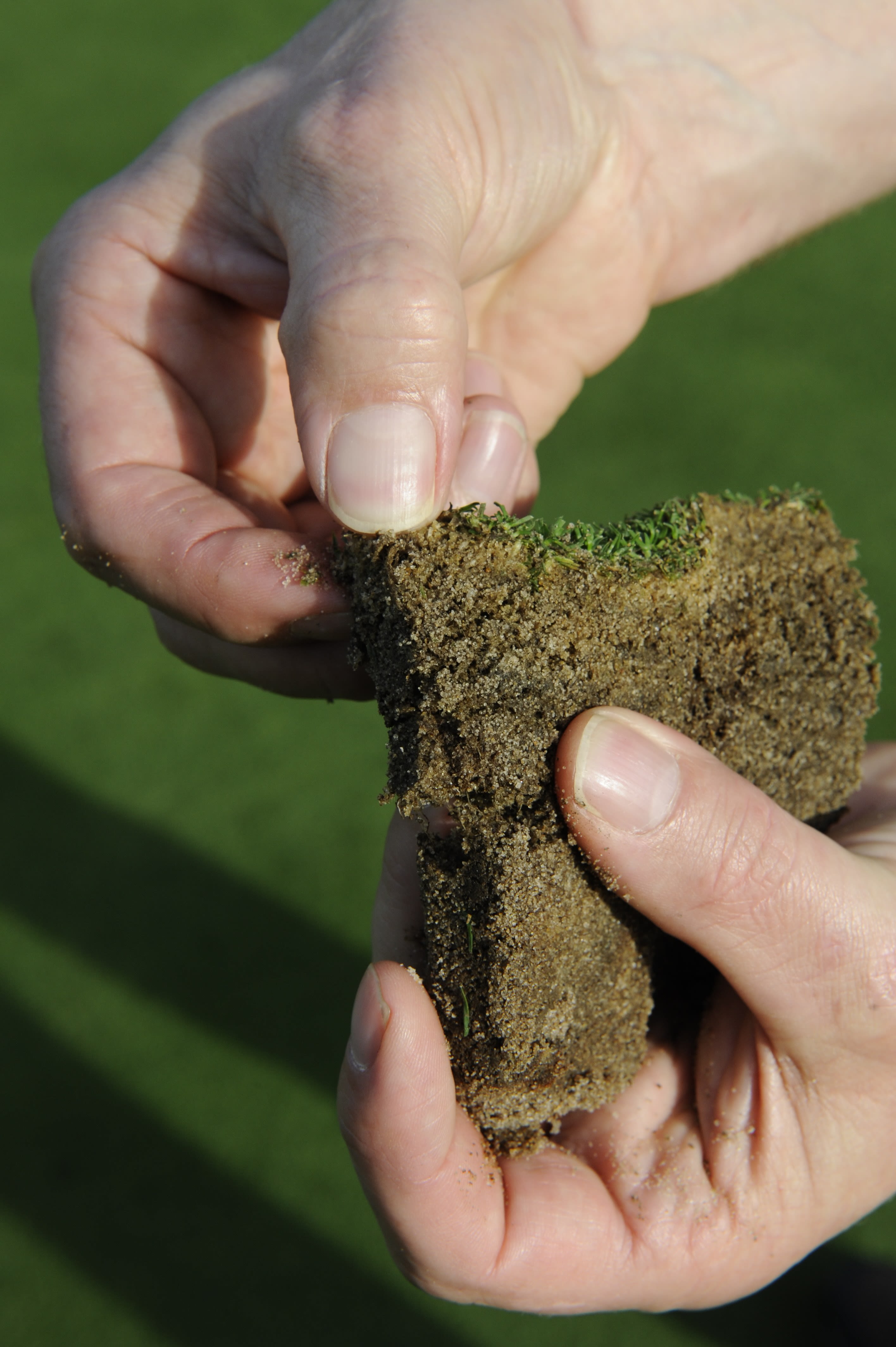
A close examination of turf on a golf course reveals how the grass copes with environmental stresses.
A close examination of turf on a golf course reveals how the grass copes with environmental stresses.
At STRI (formerly the Sports Turf Research Institute) in West Yorkshire, UK their experts understand that turf is a living system.
Sam Swires, R&D Operations Manager at STRI, says: “In the UK, we have traditionally worked with moderate temperatures. However, increasingly extreme heatwaves are changing the pressure on these surfaces. Cool-season grasses can struggle with higher temperatures, and it is not only heat that needs consideration. High-light intensity, water demand and surface wear all combine to push the plant harder. Turf cannot move into shade, take on water when it chooses, or reduce its workload. It experiences full exposure to the sun while being cut, rolled, played on and is still expected to deliver a consistent, world-class performance.”
He continues: “An ever-changing climate is driving an increasing need for research in this area. STRI has worked on areas such as soil surfactants, which can help aid moisture movement and improve the consistency of water through the profile, giving turf managers better control during periods of high evaporative demand. We have also researched UV-blocking technologies designed to reduce the intensity of light reaching the plant during stressful conditions.”
Meanwhile, Syngenta scientists are working on a new version of Ryder® which will offer the same UV protection but in a clear, uncolored format. Watch this space.
