

The tree doctor will see you now
How tree injections are protecting palms and pines from invasive pests
Every year, invasive pests destroy millions of trees worldwide. A targeted treatment, delivered one injection at a time, is changing the odds.
Every year, invasive pests destroy millions of trees worldwide. A targeted treatment, delivered one injection at a time, is changing the odds.
It’s less than 200 years since humans discovered the benefits of vaccination injections. In the tree world, however, the practice of trunk injection dates back to the 12th century.
Nine hundred years ago, injections were used to color and flavor plants. By the 15th century, there were reports of Leonardo da Vinci injecting arsenic into apple trees to deter thieves.
Today, endotherapy has evolved into a personalized treatment for plants and trees at risk from disease. A tree technician visits species such as palms, pines and horse chestnuts for their annual injections. But how does it work?
Injecting for protection
Tree injections harness a tree’s natural ability to suck up nutrients. This is known as xylem transport – vascular tissue that transports water and dissolved mineral nutrients upward from the roots to the stems and leaves. When the tree does this, the product injected into the base of the trunk to tackle pests gets taken up too.
“When we inject a tree, it’s an immediate solution,” explains Diego Salvador, Syngenta’s Technical and Biological Manager for the Landscape Portfolio across Europe. “We let the tree move it to its upper parts which are being affected by pests. So, the ecosystem around the tree can coexist and only the pest which is creating damage will be affected.”
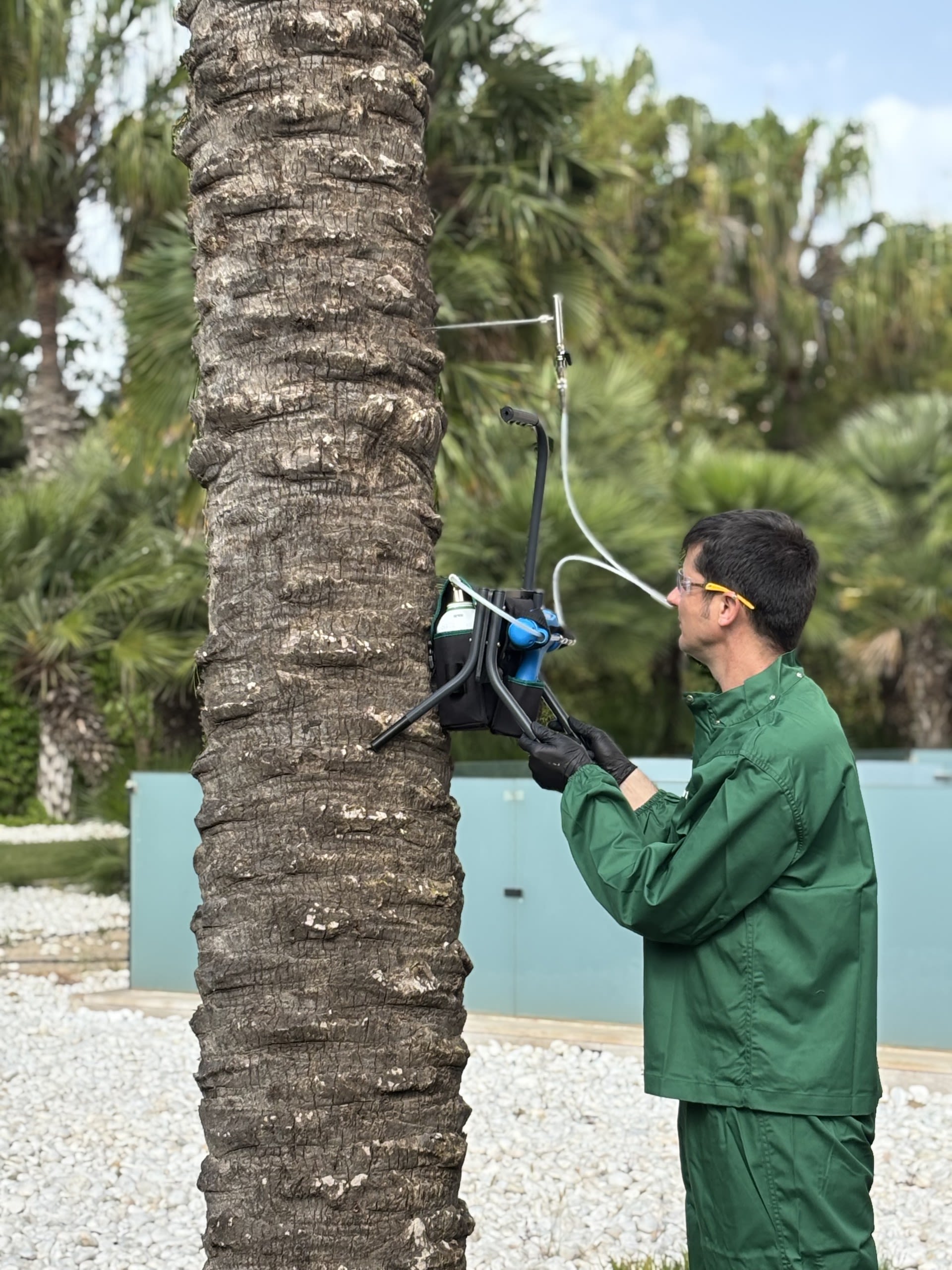
Protecting environments in close proximity to trees is essential, and the stakes are often higher in cities where trees and people share the same space.
Diego says: “Green areas in a city, such as parks where people are eating and drinking outdoors, can be crowded. If we used a spraying system for the tops of the trees, it would create a mist, and the products would be taken by the wind to where people are present. We want to minimize any contact with our plant protection products.”
Tree injections also limit the exposure of pest treatments to other insects, birds and wildlife. There is a ‘zero drift impact’ on the surrounding area, including water and soil. This is targeted pest management at its most efficient, ensuring precise dosage is directed to the tree’s canopy and pests.
While the principles of endotherapy may be centuries-old, the pest challenges for trees, including palms, pines and horse chestnuts, have intensified in recent years due to climate disruption and increased international trade. For example, the growth in popularity of palm trees for landscaping and commercial use can cause significant physical and economic damage when infested trees are shipped around the world.

Tree injections ensure that precise dosage is directed to the tree’s canopy and pests.
Tree injections ensure that precise dosage is directed to the tree’s canopy and pests.
A 21st century approach to tackling the red palm weevil
Take the red palm weevil, for example. Initially discovered in South Asia, it has since marched across nearly 50 countries leaving a trail of devastation in its wake. According to the International Center for Agricultural Research in the Dry Areas (ICARDA), each year the red palm weevil is responsible for an estimated $2 billion in crop losses and the infestation of around 35 million trees.
Its strength is its stealth. A key pest in France, Italy, Spain, Croatia, Greece and the Middle East, the larvae of the red palm weevil burrows into ornamental palms and date palms, causing serious rot and die back of tree crowns. Eventually, and often without warning, the tree collapses.
Pine processionary moth
Another invasive species targeted by tree injections is the pine processionary moth. Native to Southern Europe, Northern Africa and parts of the Middle East, the global live plant trade has brought it further north, including Switzerland, Hungary Bulgaria and northern France. In its caterpillar stage, it poses a risk to humans and animals due to its irritating hairs and potential for severe allergic reactions. Once it takes hold of a pine tree, it causes severe defoliation.
Pine processionary moth caterpillars. Photo credit Nurullah Degri
Pine processionary moth caterpillars. Photo credit Nurullah Degri
The financial impact is hard to assess. However, iForest reported that that the pine processionary moth can cause an economic loss of around €100 per hectare.
Horse chestnut leaf miner moth
The horse chestnut leaf miner moth feeds inside horse chestnut leaves. Treatable with trunk injections, it isn’t considered as damaging as other pests as there is little evidence that it leads to tree death. But, if its caterpillars are present in large quantities, they can spread quickly, destroy much of the leaf tissue, and hamper the tree’s ability to produce seeds.
Telltale signs of the presence of the horse chestnut leaf miner include patches on the leaves, leading the foliage to turn brown and trees to drop their leaves early.
The same product can be used to treat all three of these pests: Revive® II. Prior to use, technicians must hold the required plant protection certification and complete training with a Syngenta expert. Then they can use the solution with Syngenta's tree-injection device.
Diego says: “If you drill too much, you can damage the tree. You could create an extra wound in the tree’s trunk that is not necessary for the treatment. It’s also possible to overpressure, which means that you lift the cambium tissue of the tree which is the growing point on the girth of the tree. We provide specific and professional training to avoid harming trees.”
TreeCare Academy
In 2025, Lluís Olivet attended the third Syngenta TreeCare Academy in Alicante, Spain. First launched in 2023, the TreeCare Academy is a program for Syngenta’s partner applicators, combining technical expertise and hands-on training from arboriculture specialists.
At the time, Lluís was working as a Technical Manager specializing in trunk injection, phytosanitary management and tree assessment for ENDOterapia Vegetal, a distributor in north-east Spain.
Lluís, who has since joined Syngenta as Key Account Manager TreeCare and Vegetation Management Iberia and Italy, says: “Above all, I learned the methodology for applying Revive II, which is particularly important given its distinctive low dosage rate. Tree injections are very useful because you achieve almost 100 percent control while respecting wildlife and without harming the environment.”
The TreeCare Academy is a program for Syngenta’s partner applicators, combining technical expertise and hands-on training from arboriculture specialists.
The TreeCare Academy is a program for Syngenta’s partner applicators, combining technical expertise and hands-on training from arboriculture specialists.
In previous years, the TreeCare Academy has been held in France and Italy. At the most recent program in Spain, in addition to instructions on how to inject palm trees to protect against the red palm weevil, attendees were also shown how to inject pine trees at risk from the pine processionary moth.
“The injection technique is slightly different depending on the tree and the pest,” says Kym Kis, SPS Marketing Lead, Turf and Landscape Europe, at Syngenta. “At the TreeCare Academy, we’ve been able to pinpoint each technique. For example, we did a day dedicated to the pine tree, going through the physiology of the tree itself and looking at integrated pest management. We took them out into the field and showed them the different injection technique for a pine tree. As this was a relatively new treatment for them, there was a lot of discussion including questions on where exactly in the tree to drill, what kind of plug to use, and what kind of pressure to apply.”
Treecare Academy attendees learned how to inject palm trees to protect against the red palm weevil and pine processionary moth.
Treecare Academy attendees learned how to inject palm trees to protect against the red palm weevil and pine processionary moth.
Each tree injection takes less than five minutes and protects the palm tree for up to a year, the pine tree for two years and the horsechestnut for three. Injection points are sealed with wood or biodegradable plugs.
So, the next time the doctor gives you a flu jab, spare a thought for the tree also receiving its annual injection.
Watch to learn how specialized tree technicians are using this incredible "field-to-vascular" approach to keep our urban forests thriving.
