
Dr. Mary-Dell Chilton was a true trailblazer, and like other great scientists was always willing to test hypotheses and follow where the facts led. She was a crucial figure in the history of plant science - behind the developments of both the world's first transgenic plant and the crucial technique for genetic modification known as Agrobacterium Mediated Transformation.
“The breakthrough work of Mary-Dell Chilton has been taught in academic institutes around the world. That's when I first learned about her work, along with other legendary plant scientists and geneticists who shaped our industry,” said Uri Krieger, Head of Syngenta Vegetable & Flowers Seeds R&D, explaining the reach and significance of Dr. Chilton's work.
“Her scientific rigor, innovative mindset and commitment to solving the biggest world problems, helped lay the foundations of the modern biotechnology era. She left a profound impact on the entire industry and all Syngenta R&D employees, who came to know her, or her story.”
Image

Mary-Dell Chilton as a child.
Born in 1939, in Indianapolis, Indiana, in the United States, she gained her BSc and PhD in chemistry from the University of Illinois, Urbana-Champaign at a time when a career in scientific research was often seen as out of reach for many women.
But this was just the start of a lifetime of breaking new ground. It all began with her early research into crown galls. These are growths that can develop when the bacterium Agrobacterium tumefaciens enters a plant through an injury.
At the time, there was a theory that the bacterium was in some way altering the plant's genetic structure to cause these growths. Dr. Chilton had written her Ph.D. thesis on bacterial transformation, and to her, that theory didn't seem correct.
But in testing her hypothesis she proved herself wrong, and in so doing, helped change global agriculture forever, laying the foundations for modern plant biotechnology.
A brilliant scientific mind, she continued developing her initial research and in the early 1980s led a team that created the world's first transgenic plant through the process known as Agrobacterium Mediated Transformation or AMT - harnessing Agrobacterium to add beneficial characteristics into plant genetics leading to new, improved versions. This breakthrough has helped unlock countless new innovations in plant science.
Take corn for example - by introducing genes from the common soil bacterium Bacillus thuringiensis, plants can produce insecticidal proteins, protecting the plant from some of the most devastating pests like corn rootworm. Thanks to the work of Dr. Chilton, Syngenta was the first company to commercialize a biotechnology trait in corn derived from Bacillus thuringiensis. Scientific innovations like this have been invaluable for farmers everywhere.
As Trevor Hohls, Head of Seeds R&D, says: “I am deeply saddened by the passing of Dr. Mary-Dell Chilton, a true visionary whose loss is felt across the scientific community. Her groundbreaking work did more than just advance plant biotechnology; it fundamentally reshaped how we protect our planet and support the farmers who feed it.”
Image

In 1983, Dr. Chilton joined Ciba-Geigy, a Syngenta legacy company, and over the years helped build Syngenta's leading biotechnology research capabilities. Her impact stretched beyond her pioneering science in a life that embodied the values of curiosity and collaboration. She was a passionate mentor for her students, many of whom have gone on to have landmark scientific careers of their own, and that support even extended to letting them stay at her home. So many took advantage of that hospitality her home was fondly known as the "Chilton Hilton."
For Trevor Hohls, that passion for others was central to Dr. Chilton's impact: "Beyond her monumental scientific legacy, her warmth as a passionate mentor touched countless lives, inspiring generations of researchers to pursue discovery with purpose. Her impact on our people, our agriculture, and the earth will endure for generations."
Qiudeng Que, Head of Trait Generation for Syngenta Seeds, was one of the many scientists shaped by their time working with her: “Mary-Dell has been a role model for many of our scientists. Her rigor and integrity set a standard for how we approach science every day. Many of us benefited deeply from her mentorship, which shaped our careers in lasting ways. We will always remember her kindness - she had a motherly way of being approachable, and she consistently offered thoughtful guidance and encouragement when we faced challenges.”
Image
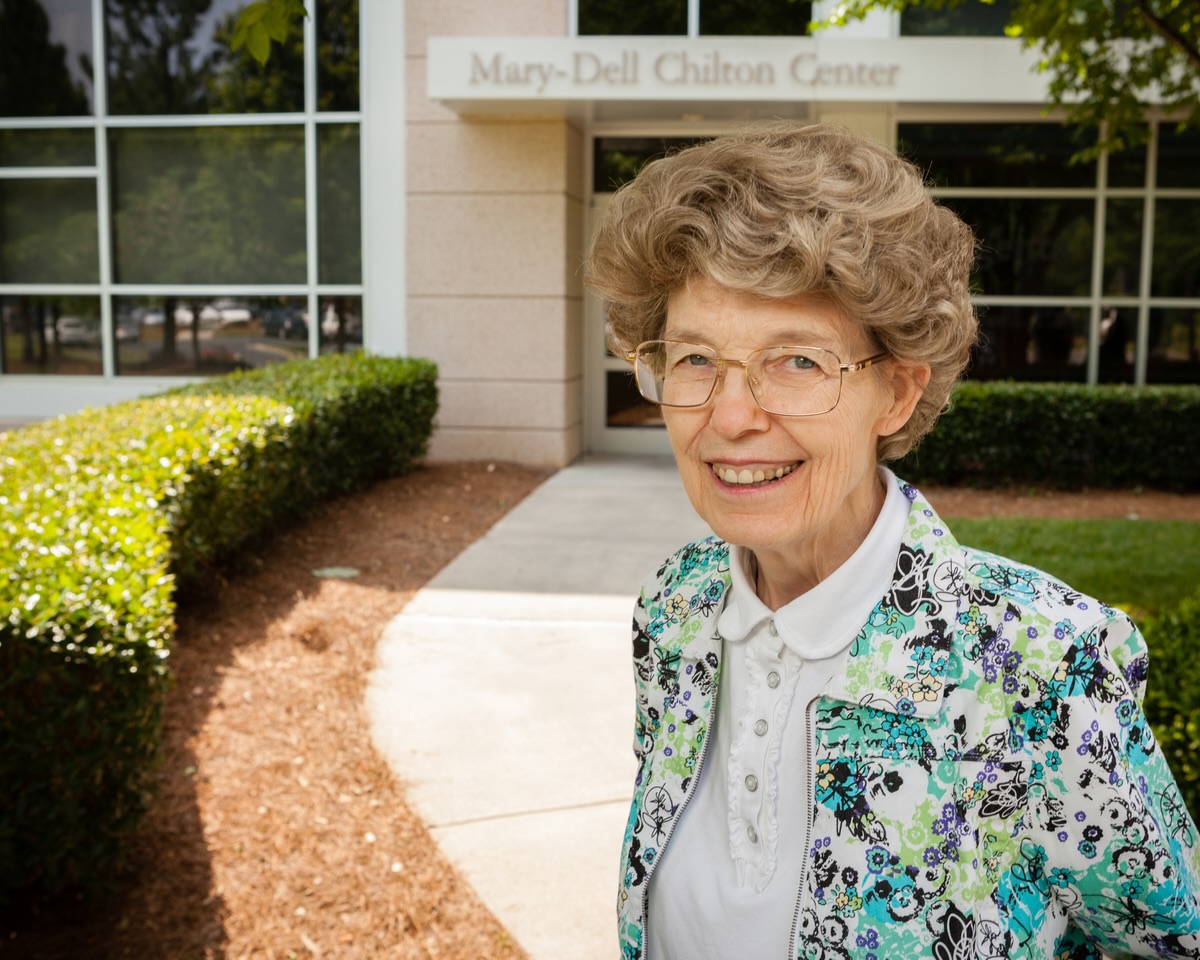
Dr. Mary-Dell Chilton retired from Syngenta in 2018 after 35 years of service, but her contributions to agriculture and humanity will endure for generations to come.
By the time she retired in 2018, she had been honored with a host of major awards including the Benjamin Franklin Medal, the World Food Prize, and the National Medal of Technology and Innovation, awarded by then-president Joe Biden. She was also inducted into the National Inventors Hall of Fame.
As Charles Baxter, Head of Global Seeds R&D Traits at Syngenta, puts it: "Mary-Dell Chilton inspired several generations of science leaders in Syngenta as she was truly a leader in her field, delivering breakthroughs that provided the foundation for a technology that changed agriculture. To borrow from Newton's famous quote; she was the giant on whose shoulders we all stand to develop new technologies that will impact agriculture."
Everyone at Syngenta sends our deepest condolences to the Chilton family, and to all who were lucky enough to know Dr. Chilton.

