What is an agricultural robot?
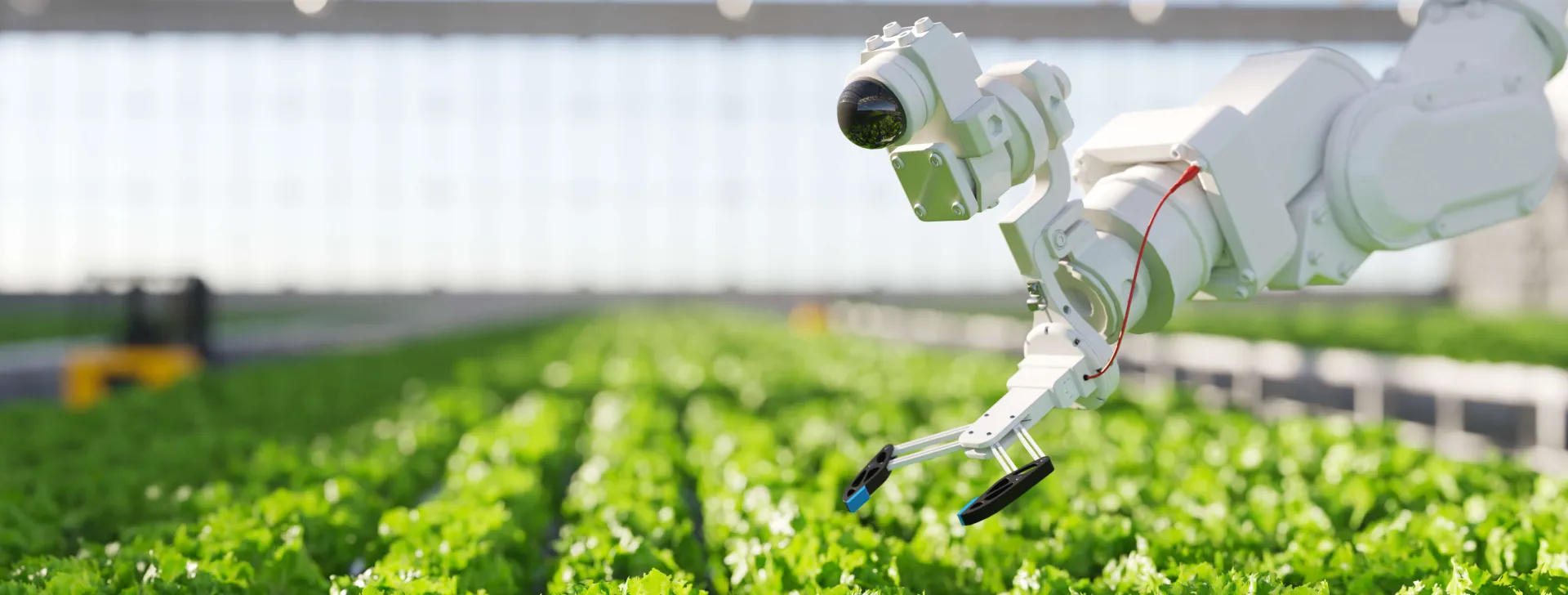
Agricultural robots are autonomous or semi-autonomous machines. In other words, they operate independently, performing tasks like monitoring, planting, spraying, and harvesting. They come in many forms from wheeled vehicles to four- and two-legged robots.
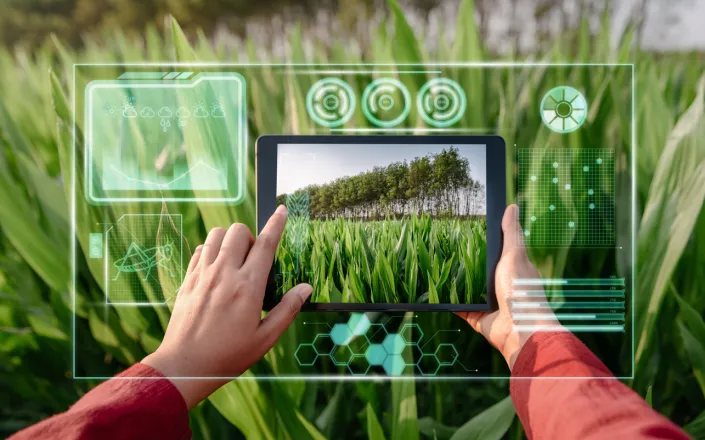
By combining robotics with sensors, cameras, real-time artificial intelligence, and data analysis, robots can help farmers make more precise, data-driven decisions and perform tasks more efficiently.
As agriculture faces a raft of challenges including labor availability and a changing climate, agricultural robots are becoming an important part of the shift towards smarter, more productive sustainable farming.
How are agricultural robots used in agriculture today?
Agricultural robots are being developed and used for tasks such as weeding, crop monitoring, pest and disease management, spraying, planting, and harvesting. These include autonomous vehicles, robotic arms, drones, and autonomous tractors which, among other things, employ satellite technology and Artificial Intelligence (AI) to navigate their surroundings and perform specific agricultural tasks.
How important are robots in agriculture and in which field are they mostly used?
While agricultural robots have already been used successfully, their use is not yet widespread. Some systems are being tested in commercial situations, but many are still in research and development. High costs, technical challenges, and the complexity of agricultural environments are some of current barriers to wider adoption.
According to a 2025 review on agricultural robotics, weed control is one of the leading applications with 26 percent of surveyed agricultural robots focused on weed control. This was followed by tool-carrying robots (19 percent), and crop or soil monitoring (14 percent). Plant protection, transport and seeding have also been identified as applications.
Agricultural robots combine technologies such as AI, computer vision, sensors, GPS, and robotics to understand their surroundings and perform specific tasks. By collecting and analyzing information about crops, soil and field conditions, robots can help farmers to optimize decision-making and automate operations that are repetitive and time-consuming.

Types of agricultural robots
Agricultural robots, including harvesting, planting, crop-spraying, and monitoring systems, utilize AI, computer vision, and advanced sensors to automate farming tasks and improve data-driven decision-making.
Harvesting robots
Agricultural harvesting robots use cameras and sensors to locate and identify fruit and vegetables before picking them. AI and computer vision help robots to recognize produce based on characteristics such as color, shape and position.
At present, apples, strawberries and other crops are being tested for robotic harvesting. However, contrasting growing conditions, including different light levels and fruit obscured by leaves, are challenges that require clever solutions. For example, a dual-arm, apple-harvesting robot was field tested in two orchards in 2024, achieving a harvesting success rate of 80 percent.
Planting and seeding robots
Autonomous tractors combine GPS, cameras, light detection, and other sensors to navigate fields and avoid obstacles. These systems support operations such as planting, seeding, and tillage, helping to streamline tasks while allowing farmers to oversee operations.
Crop-spraying robots
Robotic systems and drones identify areas in need of treatment and apply targeted crop protection using imaging with sensors. For example, agricultural drones can monitor crops and adjust the amount of spray applied in real time. Start-up companies like EAVision develop agricultural drones designed to automate spraying operations and support more precise applications.
Monitoring robots
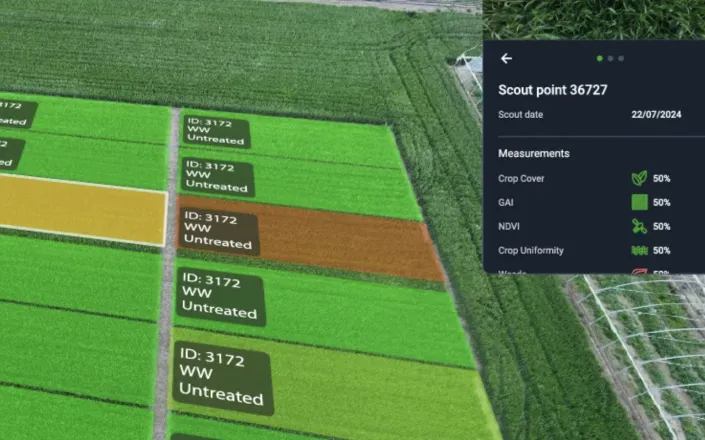
Monitoring robots use sensors, cameras and imaging technologies to collect information about crops and soil. Different types of imaging can help to identify fluctuations in crop condition and plant health, giving farmers information that can support more data-driven decisions.
An agricultural robot works by sensing its surroundings, interpreting the information it collects and then taking action. Cameras, sensors, and positioning technologies help them to recognize crops, soil and obstacles, while real-time AI and computer vision support decision-making. The robot can then perform tasks like navigating between crop rows, identifying plants, or harvesting produce.
What crops can harvesting robots handle?
Harvesting robots are being developed and tested for numerous crops including apples, strawberries, raspberries, asparagus, and tomatoes. Computer vision helps robots to locate and recognize this produce, although hidden fruit, varying crop shapes and changing light conditions remain challenges.
At Syngenta’s TomatoVision research facility in the Netherlands, AI, data and robotics combine to explore and develop the tomatoes of the future. Robots help researchers identify plant structures that are better suited to machine harvesting, while machine learning allows continual improvement of the systems.
Haoyang Duo, a senior breeder at TomatoVision, explains: “The robot can be adapted to different varieties for the best results…We want to identify varieties that can be harvested by the robot easily.
Do agricultural robots only work in greenhouses or can they operate in open fields?
Agricultural robots operate in both greenhouses and open fields. Autonomous tractors, for example, use GPS and cameras, as well as Light Detecting and Ranging (LiDAR) to navigate open fields. Outdoor environments are more challenging because robots must navigate changing terrain, weather, crops, and obstacles.
How do agricultural robots move without damaging plants or soil?
Cameras, sensors, GPS and LiDAR help robots to understand their position and detect obstacles. LiDAR works with computer vision in glasshouses where GPS does not work. Their small, lightweight designed help them move between crop rows without damaging plants. Syngenta's Robodog, for example, uses its four legs to navigate crop rows while collecting plant data.
Syngenta’s Robodog demonstrates how robotics can support crop monitoring. Fitted with high-quality cameras and computer vision technology, the robot captures detailed three-dimensional images of plants while identifying weeds and other crop threats. Its ability to navigate crop rows without damaging plants or disrupting the soil provides agronomists with detailed information that can support more targeted interventions.
Agricultural robotics is continually evolving, with new opportunities for robots to navigate, collaborate, and adapt to different farming environments. Key areas of research include improved environmental mapping and route planning, human-robot and machine-robot collaboration, and greater adaptability in different agricultural environments.
The technology is advancing with investment companies and research groups showing increasing interest as prototypes appear more frequently at major technology events.
What are the current market trends?
One emerging trend is a shift towards multi-robot systems. So, instead of one large autonomous robot carrying out every task, future systems could involve multiple robots working together, sharing information, and coordinating tasks.
How are agricultural robots changing the farming industry?
Agricultural robots are helping farmers move towards greater automation, greater use of precision agriculture, and data-driven decision-making.
These technologies can reduce exposure to potential hazards and support the use of smaller, lighter machinery.
Read more about agricultural technologies